The central goal of my research is to understand how biodiversity is generated, lost, and maintained. I focus primarily on squamate reptiles (lizards and snakes), the coolest animals on Earth. My research combines natural history, morphological, geographical, genetic and, more recently, physiological information to answer questions that will ultimately help us understand the mechanisms generating the patterns detected at large taxonomic, temporal and spatial contexts. Click here to download my CV.
I describe below some of my research interests and projects:
I describe below some of my research interests and projects:
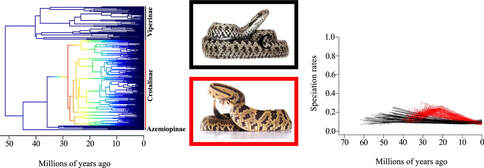 Speciation regimes during the radiation of vipers (Alencar et al. 2016 Mol Phyl Evol)
1. Ecological drivers of macroevolutionary dynamics in lizards and snakes
The tree of life is characterized by rapidly diversifying lineages and others with slow rates of species accumulation. The availability of ecological opportunities can often explain this disparity, and squamate reptiles (lizards and snakes) can exemplify this phenomenon. This group shows remarkable heterogeneity in their diversity with intriguing variations in species richness, phenotypic and ecological traits across clades. At the same time, they have successfully colonized a myriad of habitats and microhabitats, consuming different prey types, and inhabiting nearly every part of the world. By examining squamates, we can gain valuable insights into the mechanisms driving such diversification patterns and the ecological factors shaping the evolution of biodiversity. In the past, I explored the diversification dynamics of vipers, and found that the interplay between the evolution of loreal pits and dynamic environmental changes prompted a series of rapid speciation events in this amazing group of snakes (Alencar et al. 2016). I also found that morphology evolves under a much more limited trajectory in arboreal vipers than in terrestrial ones despite not observing any difference in the pace of species formation (Alencar et al. 2017). In my most recent study, I focus on Pleurodonta lizards (e.g., anoles, fence lizards, iguanas) to untangle key ecological drivers of diversification. I found that viviparity (live bearing) seems to accelerate diversification, yet its impact is exaggerated by species occurrence in Andean mountain. Similarly, larger body sizes enhance diversification rates, but this effect is limited to specific ecological and geographical contexts (Alencar et al. in revision).
2. Population-level mechanisms driving species diversification across macro scales
Estimating the rates at which lineages accumulates (e.g., speciation rates) allows macroevolutionary biologists to delineate how speciation dynamics change between lineages and over geological time scales. Yet, the question of how these rates, measured across the geological time, are governed by population-level processes remains an unresolved conundrum in macroevolution. I am interested in developing and applying mechanistic approaches that link population processes with macroevolutionary patterns. In Alencar & Quental (2021), we argue that to generate the rates observed at the macro-scale, population-level mechanisms need to act in concert. We suggest that the interaction between the timing of reproductive isolation and how quickly populations expand geographically should change phylogenetic patterns and speciation rates.
The tree of life is characterized by rapidly diversifying lineages and others with slow rates of species accumulation. The availability of ecological opportunities can often explain this disparity, and squamate reptiles (lizards and snakes) can exemplify this phenomenon. This group shows remarkable heterogeneity in their diversity with intriguing variations in species richness, phenotypic and ecological traits across clades. At the same time, they have successfully colonized a myriad of habitats and microhabitats, consuming different prey types, and inhabiting nearly every part of the world. By examining squamates, we can gain valuable insights into the mechanisms driving such diversification patterns and the ecological factors shaping the evolution of biodiversity. In the past, I explored the diversification dynamics of vipers, and found that the interplay between the evolution of loreal pits and dynamic environmental changes prompted a series of rapid speciation events in this amazing group of snakes (Alencar et al. 2016). I also found that morphology evolves under a much more limited trajectory in arboreal vipers than in terrestrial ones despite not observing any difference in the pace of species formation (Alencar et al. 2017). In my most recent study, I focus on Pleurodonta lizards (e.g., anoles, fence lizards, iguanas) to untangle key ecological drivers of diversification. I found that viviparity (live bearing) seems to accelerate diversification, yet its impact is exaggerated by species occurrence in Andean mountain. Similarly, larger body sizes enhance diversification rates, but this effect is limited to specific ecological and geographical contexts (Alencar et al. in revision).
2. Population-level mechanisms driving species diversification across macro scales
Estimating the rates at which lineages accumulates (e.g., speciation rates) allows macroevolutionary biologists to delineate how speciation dynamics change between lineages and over geological time scales. Yet, the question of how these rates, measured across the geological time, are governed by population-level processes remains an unresolved conundrum in macroevolution. I am interested in developing and applying mechanistic approaches that link population processes with macroevolutionary patterns. In Alencar & Quental (2021), we argue that to generate the rates observed at the macro-scale, population-level mechanisms need to act in concert. We suggest that the interaction between the timing of reproductive isolation and how quickly populations expand geographically should change phylogenetic patterns and speciation rates.
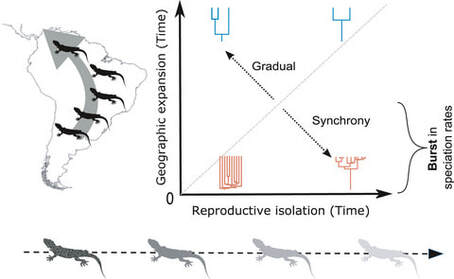
The interaction between geographic expansion and reproductive isolation can shape speciation patterns at the macro scale (Alencar & Quental 2021 EcoEvo)
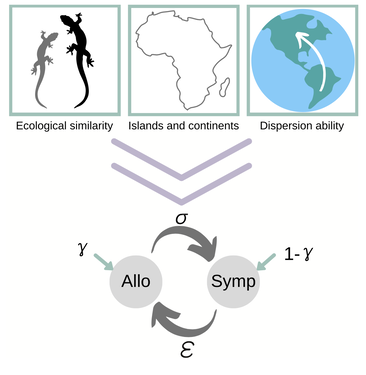 Summary of the statistical models and traits compared in Alencar & Quental 2023
3. Evolutionary and ecological paths to species coexistence
By grasping the “how”, “when”, and “where” of species coexistence, I identify the mechanisms driving variation in species richness, revealing the forces that shape biological communities. This involves integrating different sources of biological information, such as life history, morphological, physiological, and geographic information. The first work related to this project (Alencar & Quental 2023, link) relied heavily on scientific collections. Thanks to the funding provided by the São Paulo Research Foundation (FAPESP) and the Australian Museum (Visiting fellowship to LA), I was able to visit several collections to gather morphological information for several "sister" species of snakes and lizards. In this study, I found that some species of snakes coexist simply because they had more time to attain secondary sympatry (i.e., sympatric species belong to older lineages), while others had to diverge in their ecological niche to fully achieve sympatry. Species of lizards, on the other hand, mostly relied on their intrinsic ability to disperse across the geographical space to attain coexistence, as opposed to time or competitive interactions.
4. Conservation of reptiles
My research integrates different sources of information and I use these resources to inform conservation planning and strategies for squamate reptiles. In Maritz et al. (2016), we identified species that should be prioritized in conservation planning and those for which important information is still missing. We combined geographic, ecological, and phylogenetic information to create indices to identify species and geographic regions for which conservation priorities should be focused. We also investigated why some New World pitvipers are rare and how these patterns of rarity are related to their threat status, phylogenetic and ecological aspects (see Birskis-Barros et al. 2019). In his undergraduate project, Luis Gustavo Leme - supervised by Dr. Marcio Martins and co-supervised by me - developed a study to evaluate the effectiveness of the current network of protected areas in protecting Neotropical viper species (Oliveira-Dalland et al. 2022).
My research integrates different sources of information and I use these resources to inform conservation planning and strategies for squamate reptiles. In Maritz et al. (2016), we identified species that should be prioritized in conservation planning and those for which important information is still missing. We combined geographic, ecological, and phylogenetic information to create indices to identify species and geographic regions for which conservation priorities should be focused. We also investigated why some New World pitvipers are rare and how these patterns of rarity are related to their threat status, phylogenetic and ecological aspects (see Birskis-Barros et al. 2019). In his undergraduate project, Luis Gustavo Leme - supervised by Dr. Marcio Martins and co-supervised by me - developed a study to evaluate the effectiveness of the current network of protected areas in protecting Neotropical viper species (Oliveira-Dalland et al. 2022).
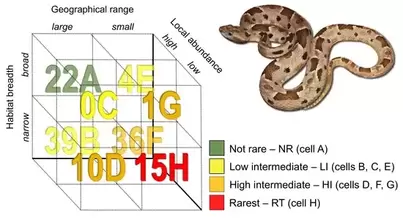
Patterns of rarity across New World pitvipers -
Birskis-Barros et al. 2019 Diversity
|
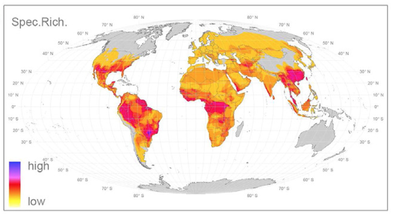
Species richness of vipers across the world - Maritz et al. 2016 Biol. Cons.
|
5. Natural history of reptiles and amphibians
Natural history is essential to the understanding and conservation of biodiversity. Many amphibians and reptiles still lack information about their natural history, and I am interested in elucidating the natural history aspects of understudied reptiles and amphibians. It is always important to recognize that all of these macro studies depend entirely on natural history. Without this basic knowledge, we cannot go much further. Thus, I am always committed to spreading the word about the importance of natural history in my research and also in the education of future biologists.
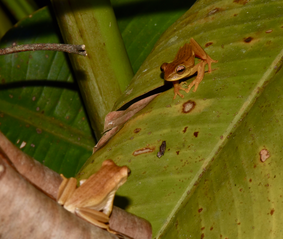
Two male Boana polytaenia in São Francisco Xavier, SP, Southeastern Brazil
|
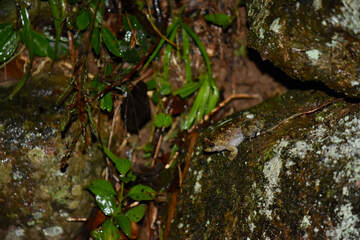
Can you see the frog?? Cycloramphus sp. in Macaé de Cima, RJ, Southeastern Brazil
|
